

 GO BACK
Scientists from Nokia Bell Labs presented results related to the SENSEI project during ECOC 2026, Europe’s leading conference in the field of optical communications, that was held in Malaga, Spain, on September 20-24.
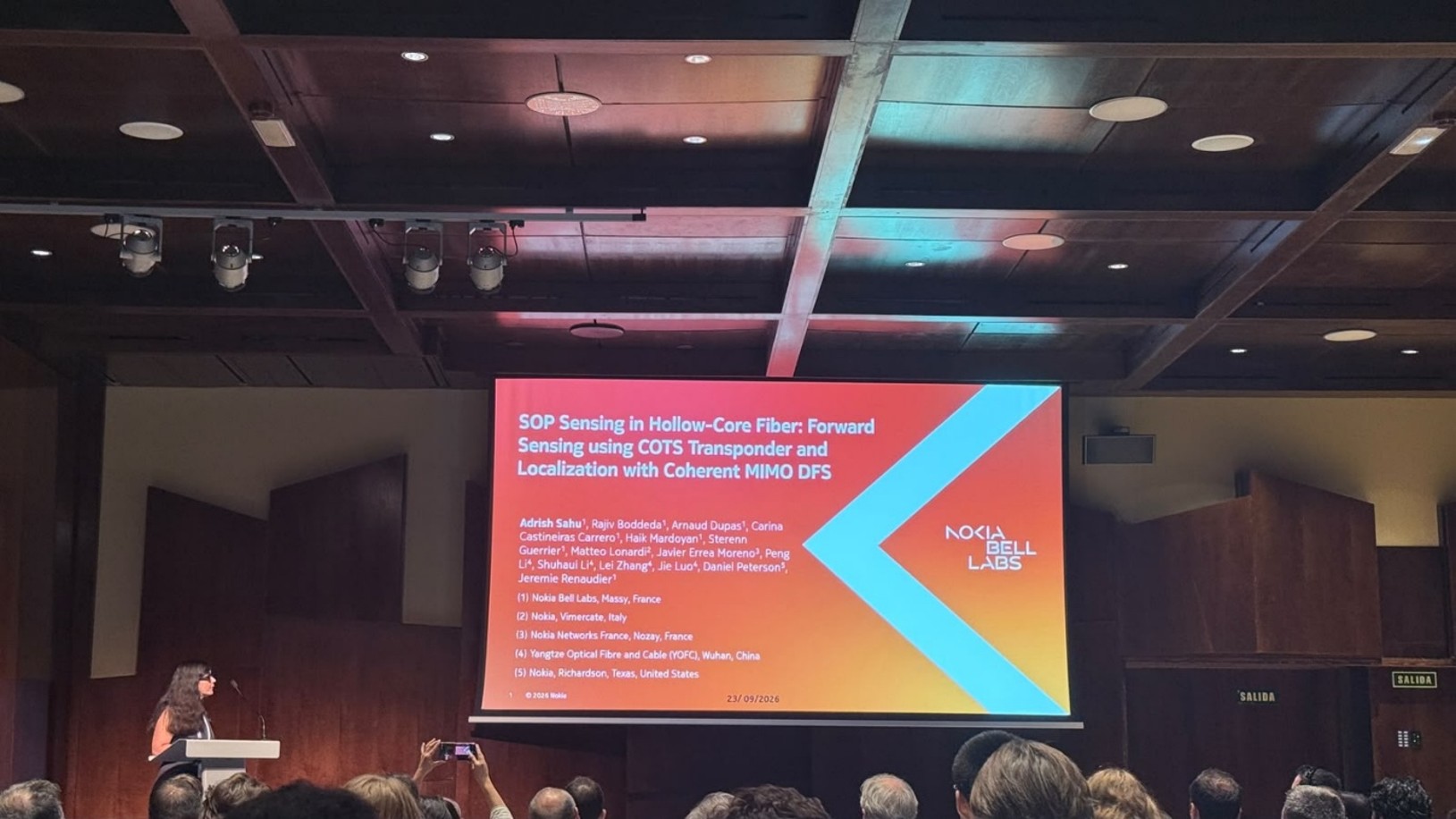
Carina Castineiras Carrero, Lab engineer transmission system at Nokia Bell Labs, joined the conference to present results on “SOP Sensing in Hollow-Core Fiber: Forward Sensing using COTS Transponder and Localization with Coherent OTDR” (picture). She presented the experimental investigation and comparison of distributed state‑of‑polarization sensing in support‑tube hollow‑core and standard single‑mode fiber. She showed that, despite significantly weaker Rayleigh backscattering and reduced polarization sensitivity in hollow‑core fiber, polarization perturbations remain observable and spatially localizable, demonstrating the feasibility of SOP‑based distributed sensing in hollow‑core fiber.
Rajiv Boddeda, Research scientist at Nokia Bell Labs, joined the workshop about “Telecom Fiber as a Geophysical Sensor for Earthquake, Tsunami and Microseismic Monitoring “. As telecom fiber networks are emerging as large-scale sensors enabling detection of earthquakes, deep-ocean tsunamis and microseismic activity, this workshop brought together photonics engineers and geoscientists to examine the suitability of distributed acoustic and polarization-based sensing for early warning, event localization and industrial monitoring applications such as carbon capture and storage. The session aimed to critically assess the realistic capabilities and limitations of using existing telecom infrastructure for seismic monitoring. Rajiv Boddeda could highlight the progress work on SENSEI with a presentation on “System Design Perspective on Fiber Sensing for Geophysical Events: Trade-Offs and Limits”.