

WORK PACKAGES
SENSEI has six work packages:
WP1
In WP1 we will develop novel photonic devices to measure strain in fibres, focusing on the analysis of optical phase and leveraging the use of highly coherent lasers. In parallel, we will address the challenge of miniaturizing laser interrogators.
WP2
WP2 implements the developed techniques in various real-field scenarios, ranging from urban areas to seabeds, and highly seismic regions. We will search for signatures of various events, targeting continued acquisition, autonomous event recognition and advanced processing.
WP3
WP3 is related to the other pillar of SENSEI, i.e. to build a global and intelligent network architecture. We will design protocols for communication between sensing nodes and the network control layer. Based on them, we will turn data into actionable intelligence for supervising the Quality of Transmission, the cable infrastructure and the environment.
WP4
WP4 implements five showcases of the developed technologies in real-world contexts, addressing resource optimization and cable integrity supervision, earthquake detection and localization, and structural health monitoring of buildings using the fibre-to-the-home architecture.
WP5
In WP5 we will endeavour to engage a broader audience with dedicated initiatives. One of the most important actions will be to make collected datasets systematically available and smoothly explitable by the scientific community, in line with FAIR principles.
WP6
Our consortium includes 15 partners from public institutions and companies, and covers complementary expertise in photonic development, metrology, geoscience, optical networking and network provisioning. Coordination is essential to boost synergies and reach ambitious goals.


WP1 will develop photonic sensing devices for detecting optical fibre deformations. We focus on techniques where strain is converted into a change in the optical phase or polarization accumulated by laser radiation as it travels through a fibre.
We will explore both forward detection and backward-detection strategies, targeting different application scenarios. Forward-detection is the only technique available today for repeated, unidirectional links such as regional or global ones. Backward-detection, based on the collection of backscattered light, cannot be applied to those infrastructures but is relevant to pinpoint local effects such as anthropogenic ones (e.g. vehicle traffic, construction works and intrusions) in urban scenarios, e.g. exploiting Passive Optical Networks.
On both approaches, we will investigate modulation formats, complex probing strategies and data processing methods that improve quality of localization, reach and sensitivity. For the latter, we will leverage the use of highly coherent laser radiation as an asset to reduce jitter and improve resolution. Lasers with the required spectral properties are today complex and bulky devices, generally hosted in specialised laboratories. Thus, in parallel, we will also work on the integration of these sources in cm-scale form factors, to ensure sustainability of this approach for global scale implementation on the long term.
Our consortium puts together a variegated playground (see map), covering fibers in the Mediterranean Sea as well as Passive Optical Networks in metropolitan areas and regional ring architectures, managed in collaboration with National Research&Education Networks, public Institutions and commercial providers.
We will apply the developed techniques to the detection of geophysical signals in some of the most seismically active European areas: southern Europe and its seas (France, Italy, Malta and the Med. Sea) and Iceland. Large part of our work also focuses on demonstrating the detection of anthropogenic events: vehicles, potential cable damages and intrusions. For this, we will use a large set of terrestrial cables in Italy and France. Such a diversified testbed will maximise chances to catch relevant events, overcome architectural constraints and ensure best match between each sensing technique and targeted use-case.
We aim for continued acquisition, clusterization of spotted events and advancement in the ability to interpret collected data. Where the network architecture allows, we will compare our recordings to DAS which enables deeper inspection and validation; in other cases, we will search for correlations with events recorded by other sensors (seismometers or weather stations). Automated recognition, unsupervised machine learning and advanced processing routines will be crucial for data reduction and analysis.

Existing network architectures already implement basic alerting services and asynchronous notification of signal degradation, although on coarse timebases or upon failures. Moreover, existing surveillance systems are mostly based on single- or few-parameter optimization. SENSEI aims to obtain a global and holistic view of the network in its wholeness and improve monitoring by a multi-parameter analysis. For this, we plan to operate conventional network elements as photonic sensing devices. As sensors, they can measure both metrics for the data transport integrity and parameters related to events on the infrastructure surroundings. These data can be used to build and update a dynamical and accurate network digital twin usable for an optimized control.
By orchestrating the rich variety of datasets gathered from standard network elements and photonic techniques alien to it, and developing real-time methods for their processing, we will provide the network with a global awareness that can be leveraged to improve knowledge of evolving scenarios and engage counteractions in case of need.
We believe such a holistic approach is the only credible path to close the circle: data collection > interpretation > alerting > decision and address critical tasks such as damage prevention or citizens protection.
Putting the developed technologies altogether, we address five applications of network sensing.
Resource optimization and cable integrity supervision. Thanks to integrated telemetry, we will produce a dynamical digital twin of a test-network, which we will operate under optimal, lowest-energy control conditions. We will include in this architecture one of the alien sensing techniques developed within WP1, showcasing a heterogeneous, yet harmonised, architecture for distributed monitoring.
Earthquake monitoring with polarization data in terrestrial coherent links. What is the minimum earthquake detection threshold for state-of-polarization analysis in terrestrial environment? Does fiber birefringence give insight into asymmetric stress, bending and twisting of optical fibres? And what is the difference with phase-based detection? We address these and other questions looking into polarization data produced with conventional transceivers and comparing them with phase data over the same cables.
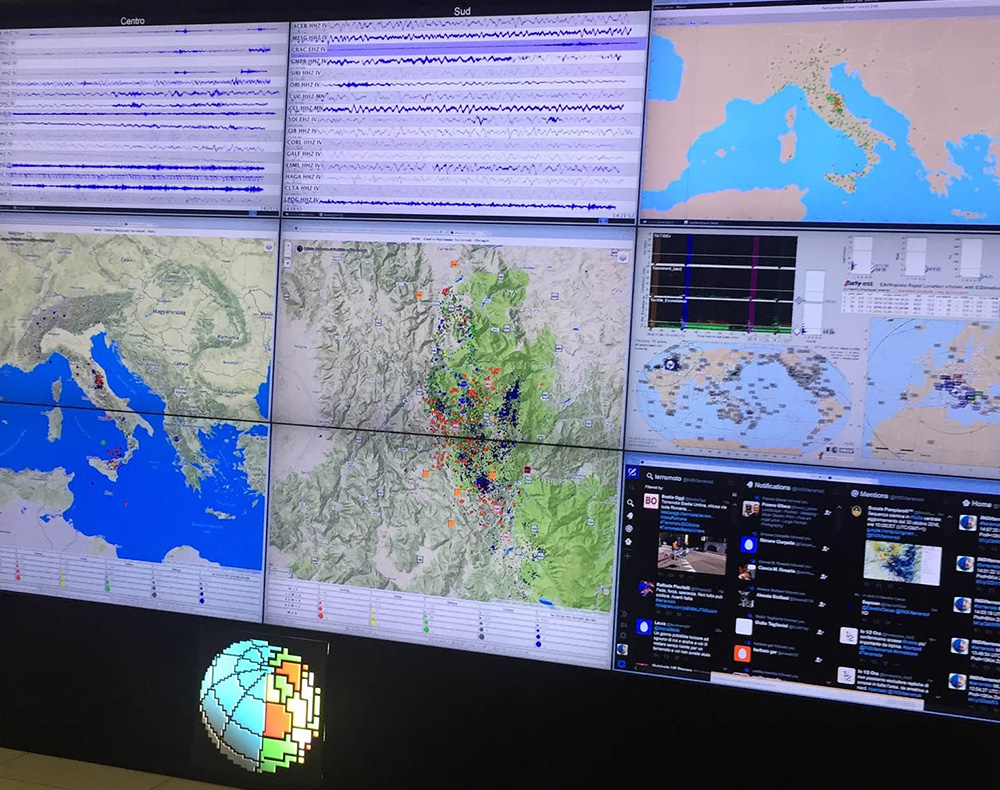
Integrating fibre sensing into seismic surveillance systems. Large data volumes, the non-localised nature of the sensing element and lack of automated processing algorithms are some of the obstacles in the road toward this goal. We address these points and leverage on the widely scalable, low-data-throughput techniques developed in WP1 to integrate fiber sensing into the Italian national seismic monitoring service.
Earthquakes localisation with fibre links in remote areas. Fibers are precious for earthquake detection in the oceans. However, localization requires to combine data from more links. We evaluate which topologies are better suited for earthquake detection in sparsely monitored remote areas. Prolonged field-tests performed throughout the project on different testbeds will enable us to compare the model with experimental results.
Fibre-based monitoring of buildings using the fibre-to-the-home (FTTH) architectures. Using fibers of the widespread FTTH architecture, we look for signatures of the buildings modal frequencies and structural settlements. Agile, compact and cheap interrogators as developed within WP1, with a minimal impact on the existing infrastructures, are a key asset for this demo.
ph. credits: www.ingv.it
SENSEI outcomes hold potential for a disruptive impact on society at various levels. We aim to engage potentially interested communities with dedicated initiatives, such as the two Workshops that will take place within the project life.
We will collect large datasets from the experimental testbeds and plan to make them available on open repositories in compliance to FAIR principles to enable exploitability. We believe our choice to share collected data may engage other researchers outside the Consortium in modelling, data analysis, and interpretation as carried out by SENSEI members. Contact us if you are interested!
WP6 will deal with the project coordination. It will include reporting, management and risk mitigation tasks, to ensure everything goes smooth and maximize the project outcomes.