
 GO BACK

SENSEI consortium partners from CNRS, INGV and the University of Malta joined the European Geosciences Union (EGU) General Assembly (EGU 2026), held in Vienna (Austria), in early May, to present results on fiber-optic sensing for geosciences.
- Debanjan Show, CNRS research engineer at LPL lab, presented results on “Long range Coherent-Optical Frequency Domain Reflectometry for large scale distributed sensing” (EGU26-13083, session SM3.4 Fibre-optic sensing for Geoscience). His team demonstrated a simple, robust, field-deployable coherent optical frequency domain reflectometry of 410 km with a km-scale spatial resolution by using a low frequency noise laser.
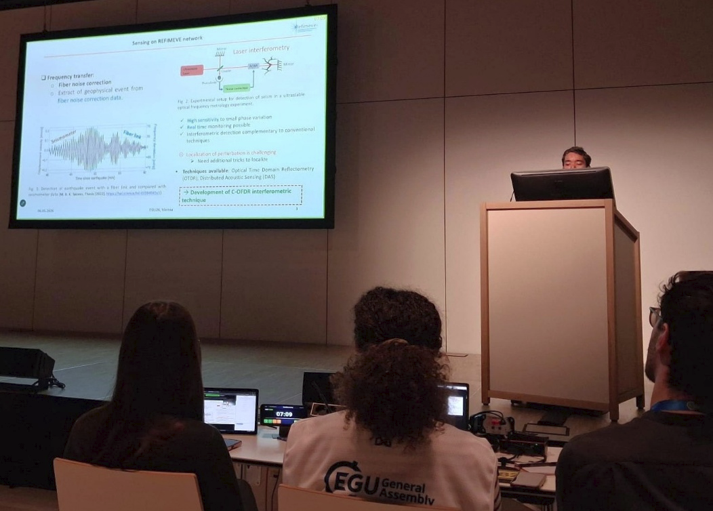
- Diana Latorre, from INGV, presented the contribution “Enhancing Earthquake Location in the Central Apennines (Italy): A Hybrid Approach Combining Arrivals from Line-Sensor Telecom Fiber Interferometry and Traditional Point-sensors” (EGU26-15227, session SM3.4 Fibre-optic sensing in the Geosciences). The work demonstrates a hybrid earthquake location approach that combines P- and S-wave arrival times extracted from seismic strain measurements obtained through coherent laser interferometry on a 39-km telecommunication fiber link with data from conventional seismic stations. By treating the fiber as a continuous line sensor within a modified NonLinLoc framework, the study shows a significant reduction in hypocentral depth uncertainty and highlights the potential of telecom fiber interferometry to enhance seismic monitoring in areas with sparse station coverage and offshore regions.
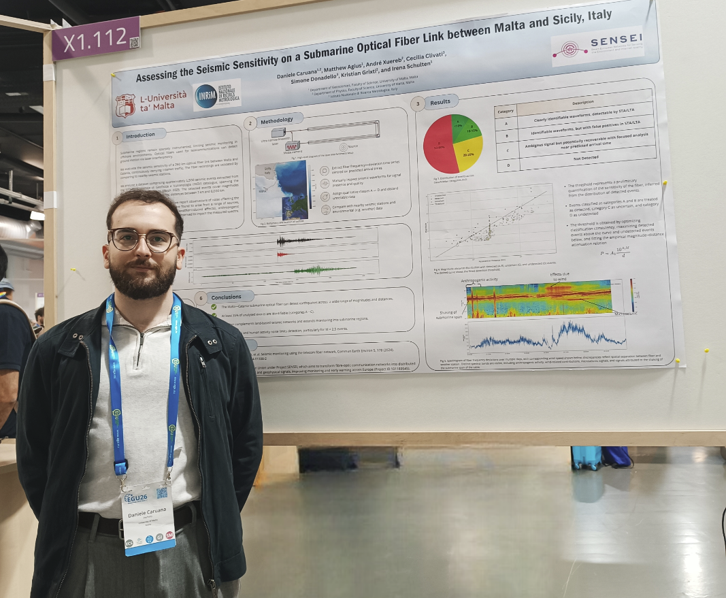
- Daniele Caruana, from the University of Malta, presented the contribution “Assessing the Seismic Sensitivity on a Submarine Optical Fiber Link between Malta and Catania (Sicily, Italy)” (EGU26-18270, session SM3.4 Fibre-optic sensing in the Geosciences). His work evaluated the seismic sensitivity of a 260-km telecommunication optical-fiber link between Malta and Catania (Italy) which is mostly submerged in the Ionian Sea, using coherent laser interferometry. Analysis of ~1500 earthquakes from the INGV earthquake catalogue between 2023 and 2025 demonstrates the capability of the fiber to record seismic signals across a range of magnitudes and distances, highlighting its potential to complement conventional seismic networks and improving offshore region coverage.