

 GO BACK
The Istituto Nazionale di Geofisica e Vulcanologia (INGV), Italy’s National Institute for Geophysics and Volcanology, is the leading research institute for Earth sciences in Italy. INGV has the fundamental role of seismic and volcanic surveillance across the nation and operates the Tsunami Alert Center for the Mediterranean Sea. Its mission extends to developing advanced research and monitoring systems to better understand geohazards and contribute to risk assessment, making it a key member of the SENSEI consortium.
Bringing deep seismology expertise to fiber-based environmental sensing
INGV brings its considerable expertise in seismology and geophysical data analysis to SENSEI. This experience is fundamental to the project’s goal of transforming fiber optic cables into a vast network of environmental sensors. To successfully interpret the subtle signals detected by the fibers, INGV applies its specialized skills in seismic signal processing, phase detection, and earthquake localization. This work is supported by the Institute’s detailed knowledge of Italian seismicity and geology, alongside its expertise in seismic source modelling and wave propagation—a crucial step in translating raw data into meaningful information.
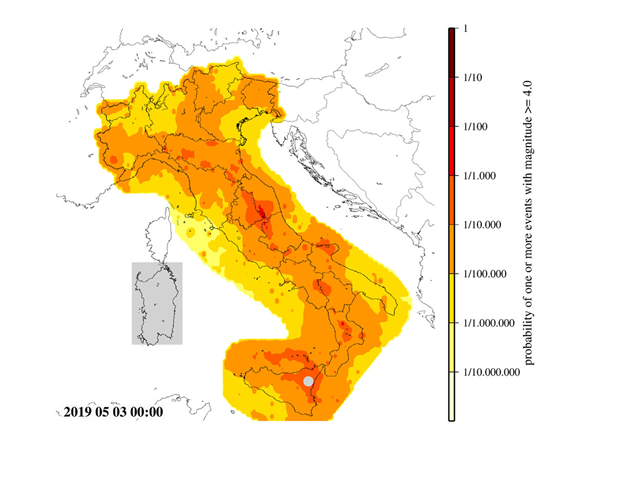
INGV’s Seismic Danger Center (CPS), was created more than a decade ago to deepen the study of earthquakes and their effects and to provide Italian’s Civil Protection with the first fundamental “bricks” on the basis of which to build Italian cities safely.
A novel approach for Earthquake localisation with fibre optics
A recent achievement that highlights INGV’s suitability for the SENSEI project is the development of a novel, hybrid approach to earthquake localization. Building on experience from the MEGLIO experiment, this work introduces a method to integrate data from traditional “point” seismometers with the “linear” data from fiber optic cables. By modifying the NonLinLoc (NLL) software, INGV demonstrated that using fiber optic cables as linear sensors within a sparse seismic network improves earthquake location resolution, particularly for determining an event’s depth. This innovative work provides a direct and practical application for the sensing capabilities being developed in SENSEI, showing how fiber data can effectively complement conventional networks to enhance performance.
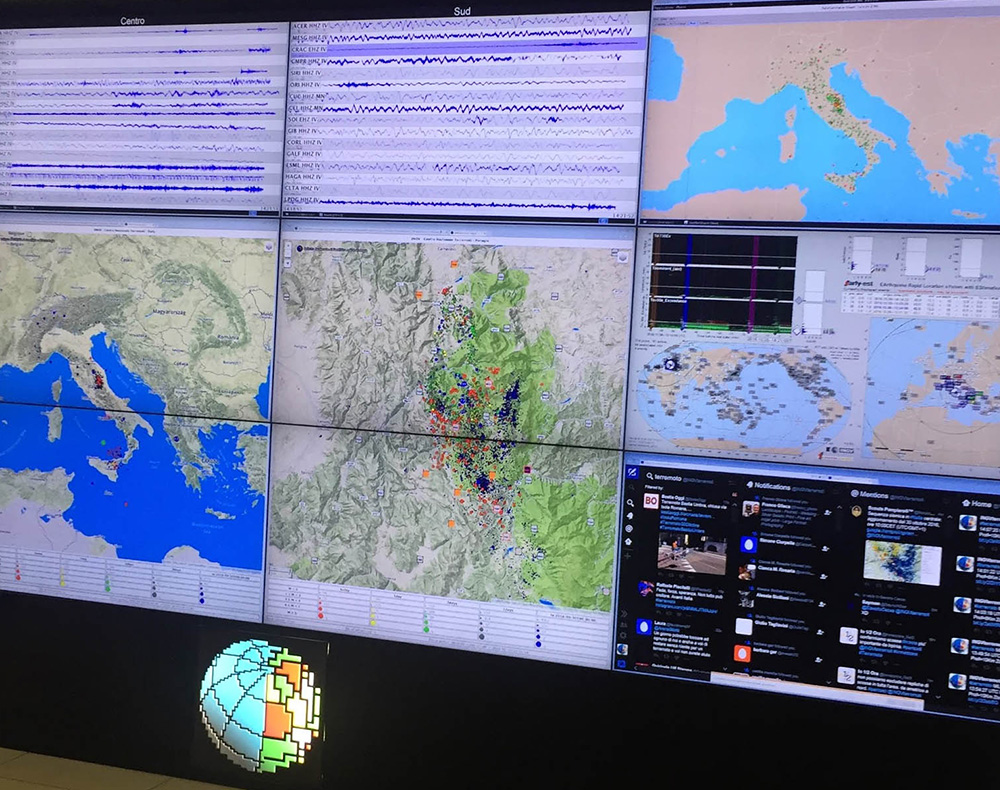
The Seismic Surveillance Room of INGV is the operational structure that detects and identifies earthquakes occurring within the Italian territory or in neighboring areas that may be felt by the population. Our aim within SENSEI is to use fibers to complement the information of conventional seismometers and improve the event’s localization. (credit: INGV)
Building a Sustainable, Resilient Monitoring Layer for Europe with SENSEI
Looking to the future, INGV sees the SENSEI project as an important step towards a new way of thinking about monitoring. The goal is not to replace existing geosensing systems, but to create a valuable complementary layer of sensing capabilities. By using existing telecommunication infrastructure for the dual purpose of sensing and communication, SENSEI promotes a sustainable model at the European level, maximizing the value of significant, already-deployed resources. INGV expects that this synergy will lead to a more resilient and densely monitored continent, strenthening Europe’s ability to respond to geological and environmental challenges.
For more information, please visit the INGV website
…more to come! Stay tuned…